Thursday, December 29, 2011

Ninjas - One of My Favourite Themes

There is no need for words here in this post. The title says it all. Oh yes, you can use them as figurines or tokens for your board games simple or complex.


Symbolism Is As Ancient As It Gets


I first heard of this Belgian artist when i was doing my Masters in Applied Linguistics, six to seven years back. This picture and his illumination of the topic helped me to realise the 'what' of symbolic representation. What do you see in the picture? Is it a pipe? No, argued Rene Magritte. It is a picture of a pipe. The words on the picture says, "Ceci n'est pas une pipe." ("This is not a pipe"). Try filling the picture with tabacco and immediately we will realise that it is not a pipe. In fact, to further the argument, i would say that what we see here is an electronic picture of a pipe.

Magritte thus named this provocative piece "The Treachery of Images. If you want to find out more about this intriguing artist, see: http://www.rene-magritte.org/

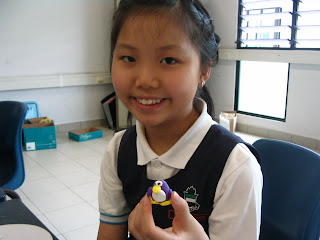
Henceforth this revelation, the penguins which I do have become "symbolic representation of a penguin." Surprisingly, when i went to a particular class of an all-girls primary school, they seemed to respond with understanding. They started saying things like:"Oh, i am now making a symbolic representation of a penguin" or a "symbolic representation of this and that." They waxed this statement until it reached a tipping point of being cool. Haha.

Wednesday, December 28, 2011

The Significance of Symbols

How do you enable and empower professionals to talk about their company or department work?

Method 1: Have an external corporate trainer provide training and facilitation. I presume a lot of technical terms and jargon will be used.

Method 2: Have the in-house trainer drill them with the Mission and Values and Strategic goals (again). OR

Method 3: Use air-dry clay to enable them to express their feelings, perspectives and the value-add that they can provide to their organisations.


Words can do that much. But an object which they make with the interaction of their left and right brains and their hearts will make a difference.


Look at the following examples and you will see the significance of using clay as symbols. The first part of the Creative Clay Conversations, which I created, is to teach them simple clay shapes which the participants can make themselves. Then the conversation begins.


"To stay healthy and happy"


" To be aligned with the mission and direction of my department"


"To play a central role in the staff development for people in different departments"


"The link between the departments"


If a picture can paint a thousand words, then using clay in creating conversations will be able to substitute ten thousand words!

MOULIN ROUGE!

Did you know that i watched this Award-winning show more than 10 times? I did it for my group assignment during my Masters in Applied Linguistics days. Director Baz Luhman (correct spelling?) did a fantastic job of directing the famous male and female leads. So much symbolism in it and so much literary stuff one can discuss.

But other than that, i love penguins and they found a way into the Moulin Rouge set
:-)

A Peek Into My Clay Studio

When you sign up for workshops with Leonard, you can be assured of a nice conducive environment to do something that you like. Ventilation is great and lighting is excellent for allowing you to see the details of your project. And because i really like what i do, you will go home with projects that you will want to keep for a long time.

Children who have come to my studio-home say :"Wow, uncle Leonard, you house is so nice!"

Thank you :-)

I use many types of air-dry clay. Because I like to experiment with new things, i am versatile with many types of clay.

Thursday, December 22, 2011

The Creative Clay Conversation

The Creative Clay Conversation is an original programme conceptualised by Leonard Kok, an experienced corporate trainer and senior facilitator of more than 10 years. A specialist in effective communication strategies, Leonard spent more than 6 years of facilitating and teaching air-dry clay to organisations in the private and public sectors.


The Creative Clay Conversation is based on the learning theory of Constructionism, which means that one learns through personal discovery of knowledge and its meaningfulness to themselves. Through the Creative Clay Conversation, participants will go through the process of self-discovery through expressing their thoughts, feelings and attitudes in creating clay artifacts that they can identify with. What we learn in the process of making things that we care about sinks much deeper into our belief system.

In this fun all-weather teambuilding activity, participants make colourful clay pieces which serve as metaphors to describe themselves, their organization and relationship with their colleagues. The session will include many creative and impactful experiential, hands-on, minds on, clay activities which engage the whole being and therefore produce honest and meaningful conversations -- conversations that bond the team.

The learning outcomes include:

1. Change Management
2. Team Vision
3. Team Envisioning
4. Infusing Corporate Values
5. Teamwork
6. Leadership styles
7. Working with limited resources

The Creative Clay Conversation enables your key stakeholders to breathe life into their own creations and transpose values into the colourful clay pieces. Instead of a file containing notes that are usually filed away, your key stakeholders bring back values which are infused into the artifacts - back to their workplace! We notice that when the stakeholders are proud of the objects they have made, they display them in their work areas. What better way to imbibe the organization's values!

Trying something new!

My perspective of lifelong learning is perhaps a view that is held by many people as well - Life is a long journey. How we make of the journey is up to us: whether we want to make it a long, boring and ardous drudgery or an exciting adventure depends on our perspective on learning as we walk life's paths.

Recently, a tuition student asked me whether i could do miniature canoe paddles for her canoe team in air-dry clay. However, i felt that it would not be realistic enough as the polysynthetic effect of the clay paddle may not convey the solid and straight, symmetrical shape of the paddles. I like wood craft and i proposed wood as a medium. She agreed. This is the result. I was very proud of myself ;-)


This is my first foray into wood craft. But it would be quite a while before i venture to start a woodcraft blog XP.